TL;DR: Water damage in Bakersfield moves fast. Slab-on-grade construction and hard water make burst supply lines and slab leaks the most common culprits, and wet materials can grow mold within 24 to 48 hours. Stop the water source, document everything with photos, call your insurance company to open a claim, and get a certified restoration crew on-site the same day. The longer standing water sits on concrete slab or soaks into drywall, the more expensive the repair.
If you just found water spreading across your floor in Oleander, Westchester, or anywhere else in Bakersfield, the first question is simple: where is it coming from? A burst supply line under a slab, a failed water heater, a leaking evaporative cooler that ran all summer, a sewage backup from aging cast-iron drains in an East Bakersfield bungalow. The source determines the water category, and the category determines how aggressively the crew needs to work. Here is what happens from the moment you find the damage to the day your home is dry. Full service details are on the Bakersfield water damage restoration page.
What Kind of Water Damage Is It?
Not all water damage is treated the same way. The IICRC S500 standard classifies water losses into three categories that drive every decision about drying, cleaning, and what materials can be saved.
- Category 1 (clean water): Broken supply lines, failed appliances, or a burst pipe. The water itself is not a health hazard, but it becomes one if it sits too long or contacts contaminated surfaces.
- Category 2 (gray water): Overflow from washing machines, dishwashers, or HVAC condensate. Contains microorganisms and chemical residue. Porous materials like carpet and drywall usually need to go.
- Category 3 (black water): Sewage backups, floodwater from outside, or any Category 1 or 2 water that has been sitting for more than 48 to 72 hours. Treated as grossly contaminated. Full PPE, containment, and aggressive material removal required.
Bakersfield’s aging housing stock adds a wrinkle here. Pre-1970 homes in Westchester and East Bakersfield often have cast-iron drain lines and galvanized supply pipes at the end of their service life. A slow drip behind a wall can go undetected for weeks, turning what started as Category 1 into a Category 3 mold situation by the time you smell it. If you are not sure what you are dealing with, treat it as the worse category until a certified inspector tells you otherwise.
How Does the Water Damage Restoration Process Work?
Professional water damage restoration follows a defined sequence. Knowing the steps helps you ask the right questions and understand what you are paying for.
1. Emergency extraction. The crew arrives and removes standing water using truck-mounted or portable extractors. On a slab-on-grade home, this means pulling water off concrete and out of any floor covering before it wicks further into walls.
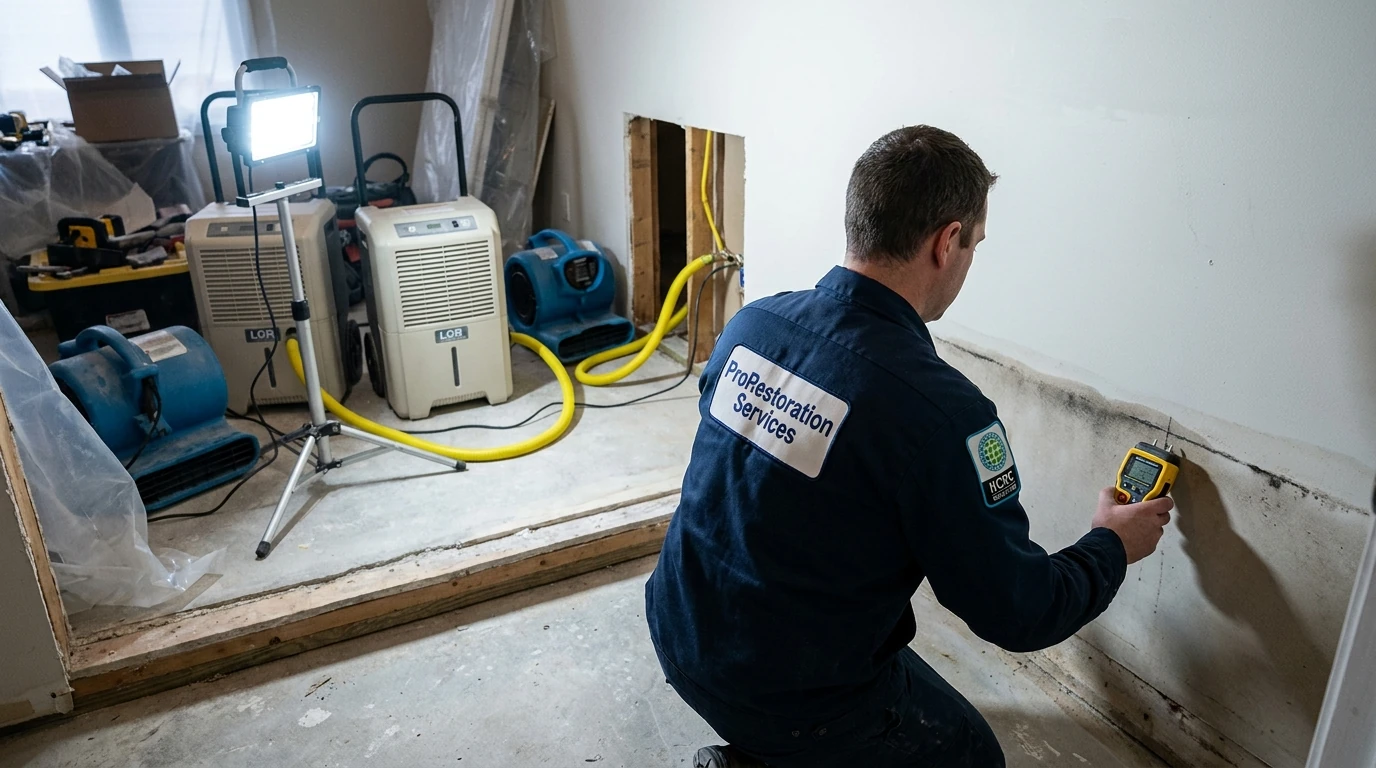
2. Moisture mapping. Technicians use thermal imaging cameras and calibrated moisture meters to find water that has migrated behind drywall, under flooring, and into wall cavities. You cannot dry what you have not found.
3. Controlled demolition (when needed). Wet drywall, saturated insulation, and soaked flooring that cannot be dried in place are removed. This is called a “flood cut” and it is not optional for Category 2 or 3 losses. Leaving wet organic material behind is how mold starts. If mold is already visible, a separate mold remediation scope is written before reconstruction begins.
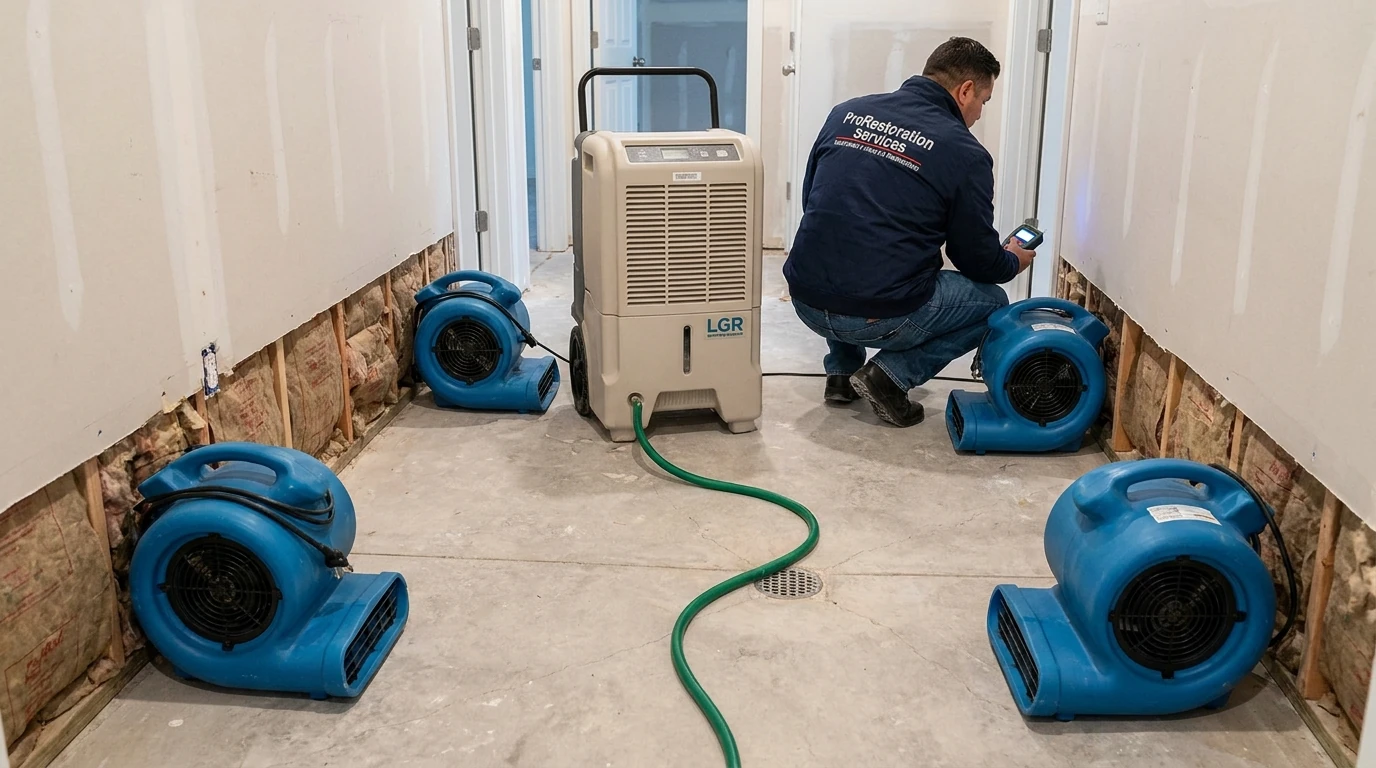
4. Structural drying. Industrial LGR (low-grain refrigerant) dehumidifiers and high-velocity air movers are positioned to create an engineered drying system. In Bakersfield’s dry climate, ambient conditions help, but the equipment does the real work inside wall cavities where outdoor air does not reach. Drying typically takes three to five days for a standard residential loss, though larger or more saturated structures take longer. For a detailed timeline breakdown, see How Long Does Water Damage Restoration Actually Take?
5. Monitoring. A certified technician checks moisture readings daily. Drying is not complete until readings return to the pre-loss baseline for that material and region, per IICRC S500 protocol.
6. Reconstruction. Once the structure passes final moisture readings, the rebuild begins: new drywall, insulation, flooring, paint, and any finish work. If your restoration company also holds a general contractor license, they can handle the full scope without you managing a second contractor.
Will Homeowners Insurance Cover This?
Most standard homeowners policies cover sudden and accidental water damage. They do not cover gradual leaks or maintenance failures you knew about and ignored. Here is how it typically breaks down in California.
Covered: Burst pipe, failed water heater, appliance supply line rupture, accidental overflow. Your policy pays for mitigation, drying, and repair to the affected structure, minus your deductible.
Not covered: Slow leaks from a corroded pipe you had not fixed, flooding from outside (that requires a separate NFIP flood policy through FEMA), or damage caused by deferred maintenance.
Slab leaks: This is where Bakersfield homeowners get surprised. Many policies cover the water damage caused by a slab leak but not the cost to access and repair the pipe itself. You may need a licensed plumber to fix the source while a restoration crew handles the water damage side. The good news: when your plumber and restoration contractor operate as one team, you make one call and both scopes get handled without a scheduling gap.
Document everything before cleanup starts. Photograph the source, the water spread, every affected room, and every damaged item. Your adjuster will ask for it, and a written scope from a certified contractor carries weight when a claim is disputed. For a full walkthrough of what to document and when, see Does Homeowners Insurance Cover Water Damage?
What Should You Do Right Now?
If the water is still flowing, stop it first. Shut off the main water supply valve. If you cannot locate it or the leak is from a slab line, call a licensed plumber immediately. Do not enter a room where water is in contact with electrical outlets, panels, or appliances until power to that area is off.
Once the source is controlled:
- Photograph everything before moving anything.
- Call your insurance company to open a claim. You do not need to wait for a contractor’s scope first.
- Move valuables and furniture out of the wet area if you can do it safely.
- Call a certified restoration contractor the same day. The 24-to-48-hour mold window is real. For a step-by-step guide to the first day, see What To Do in the First 24 Hours After Water Damage.
For Bakersfield homeowners, ProRestoration Services (license 960566, IICRC Certified, EPA Lead-Safe Certified) handles water damage mitigation, structural drying, and full reconstruction under one roof. Their sister company, All Pro Plumbing, fixes the source at the same time, so you make one call and the burst pipe gets repaired and the water damage gets restored without coordinating two separate contractors. Reach them at (661) 393-9306.
If you want to compare your options before calling, The 5 Best Water Damage Restoration Companies in Bakersfield, CA (2026) lays out the local field with verified ratings.
The worst outcome after a water loss is not the initial damage. It is the mold that grows in the wall cavity three weeks later because drying was incomplete, or the insurance claim that gets denied because documentation was thin. A certified crew with the right equipment and a written scope protects you from both.
About ProRestoration Services
ProRestoration Services is an IICRC-certified, EPA Lead-Safe Certified firm serving Bakersfield, CA and surrounding Kern County communities (CSLB license 960566). Their team handles water damage restoration, flood damage cleanup, burst pipe repair, appliance leak cleanup, sewage cleanup, mold remediation, fire and smoke damage restoration, storm damage restoration, carpet cleaning, and full reconstruction. Sister company All Pro Plumbing provides licensed plumbing repair, making ProRestoration the only local team that can fix the source and restore the damage from a single call.