TL;DR: Water damage restoration in California typically costs $1,500 to $15,000 for most residential losses. A small clean-water leak caught quickly runs $1,500 to $4,000. A burst pipe that soaks multiple rooms or a sewage backup pushes $5,000 to $15,000 or more. The biggest cost drivers are water category (clean vs. gray vs. sewage), square footage affected, and how long the water sat before mitigation started.
If you just discovered water damage in your Bakersfield home, whether from a slab leak under your kitchen floor, a burst supply line behind the washing machine, or an evaporative cooler that finally gave out through the attic, the first question most homeowners ask is: what is this going to cost me? The honest answer depends on a handful of factors that a technician can assess in the first 30 minutes on site. This guide walks through realistic cost ranges for California, what moves the number up or down, and how homeowners insurance typically responds.
How Much Does Water Damage Restoration Cost in California?
In California, water damage restoration typically costs between $1,500 and $15,000 for a standard residential loss, with the statewide average landing around $3,500 to $5,500 for a single-room to two-room event. Larger losses involving multiple floors, structural drying, or contaminated water can run $15,000 to $30,000 or more before reconstruction begins.
Bakersfield losses follow a similar pattern, though the city has a few local factors worth knowing. Slab-on-grade construction is the norm throughout Stockdale Estates, Riverlakes Ranch, and most of the southwest side. When a slab leak runs undetected, water wicks up through the concrete and saturates flooring, baseboards, and lower drywall across a wide area before anyone notices. That hidden spread tends to push mitigation costs higher than an equivalent above-slab leak would. Pre-1970 homes in Oleander, Westchester, and East Bakersfield carry aging galvanized pipe that can fail suddenly, producing fast-moving Category 1 losses that are less expensive to dry but often require more demolition to access the pipe.
Water Damage Restoration Cost by Scenario
The table below reflects typical industry ranges for California residential losses. Every job is different, and ProRestoration Services provides a written scope before any work begins.
| Scenario | Typical Cost Range |
|---|---|
| Single room, clean water (Cat 1), caught within 24 hours | $1,200 - $3,500 |
| Two to three rooms, clean water, partial flooring removal | $3,500 - $7,000 |
| Appliance leak (washing machine, refrigerator, water heater) | $2,000 - $6,500 |
| Slab leak with flooring and drywall affected | $4,500 - $12,000 |
| Sewage backup (Cat 3), one bathroom or laundry area | $3,000 - $8,000 |
| Multi-room flood, gray or black water, structural drying needed | $8,000 - $20,000+ |
| Crawl space or subfloor saturation | $2,500 - $7,500 |
These are mitigation-only figures. If damaged drywall, flooring, or cabinetry needs to be rebuilt after drying, reconstruction costs are separate and depend on finish levels and material costs in your area.
What Factors Drive the Cost Up or Down?
Five things move the number more than anything else.
Water category. The IICRC S500 standard classifies water losses into three categories. Category 1 is clean water from a supply line or appliance, the least expensive to remediate. Category 2, called gray water, comes from dishwashers, washing machines, or toilet overflows without solid waste. Category 3, also called black water, includes sewage backups and any water that has been standing long enough to grow bacteria. Cat 2 and Cat 3 losses require antimicrobial treatment, more aggressive demolition of porous materials, and stricter containment, all of which add cost.
Class of loss (how far the water spread). The IICRC also defines four classes based on how much material absorbed water. Class 1 means a small area with minimal absorption. Class 4 means specialty materials like hardwood, concrete, or plaster that require very low final moisture content and longer drying times. A Class 4 loss in a hardwood-floored Rosedale home costs significantly more to dry than a Class 1 loss in a tile-floored bathroom.
Square footage affected. More area means more air movers, more dehumidifiers, more monitoring visits, and more demo. Equipment is typically deployed based on affected square footage and the number of wet materials present.
Response time. The EPA notes that mold can begin developing within 24 to 48 hours of a moisture event. A loss mitigated within the first few hours stays Category 1 and often avoids mold remediation costs entirely. A loss discovered after a week away from home may have crossed into Category 2 or 3 territory regardless of the original water source, adding remediation costs on top of drying costs. If you want to understand the mold timeline better, see our post on how quickly mold grows after water damage.
Materials affected. Tile and concrete dry faster and cost less to restore than hardwood, engineered wood, plaster, or insulation-filled walls. Cabinets and built-ins often need to be removed to dry the wall cavity behind them, which adds labor and may not be salvageable.
Will Homeowners Insurance Cover Water Damage Restoration in CA?
Most standard California homeowners policies cover sudden, accidental water damage but exclude gradual leaks and flooding from outside the home. A burst pipe, a washing machine hose that fails overnight, or an ice maker line that lets go are typically covered events. A slow drip under the sink that went unnoticed for months is typically excluded as a maintenance issue.
Flood damage from surface water, including storm runoff and rising rivers, requires a separate flood insurance policy through the National Flood Insurance Program or a private carrier. This matters in Bakersfield neighborhoods near the Kern River Parkway and in lower-lying areas that saw flooding during the 2023 snowmelt event.
For covered losses, your insurer will typically pay for mitigation (drying, demolition, antimicrobial treatment) and reconstruction to pre-loss condition, minus your deductible. The documentation you provide in the first 48 hours, photos, moisture readings, a written scope of work, directly affects how smoothly the claim moves. ProRestoration Services works directly with insurance adjusters and provides the documentation required to support your claim.
For a deeper look at what policies typically cover and exclude, see our guide on does homeowners insurance cover water damage.
What Does the Water Damage Restoration Process Actually Involve?
Knowing the phases helps you understand the invoice and set realistic expectations for timeline.
-
Emergency extraction. The crew removes standing water using truck-mounted or portable extractors. For a flooded room, this step can take one to three hours. Getting water out fast limits how far it spreads into walls and subfloors.
-
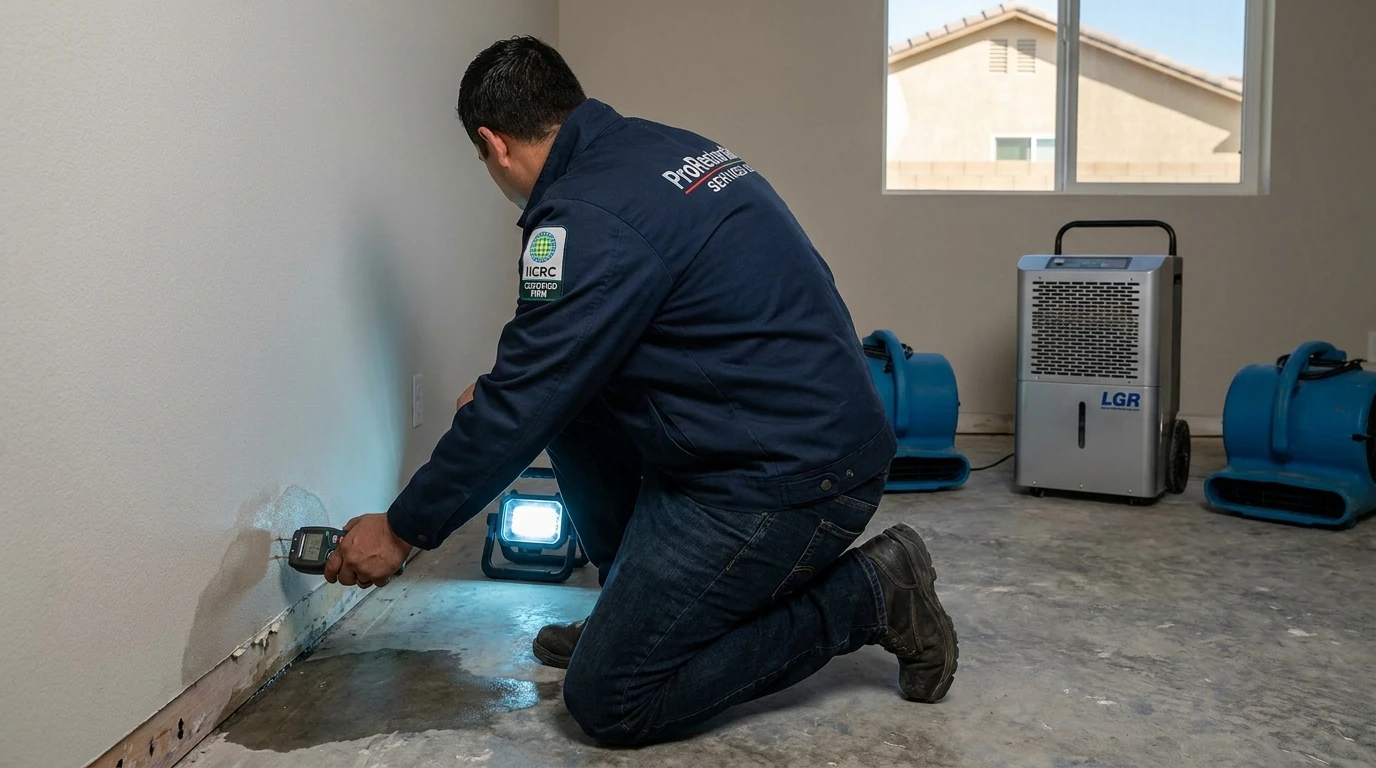
Moisture mapping. Technicians use thermal imaging cameras and penetrating moisture meters to find water that has migrated beyond the visible wet area. In slab-on-grade homes, this step is especially important because water travels laterally under the slab and can appear in rooms far from the source.
-
Controlled demolition. Wet drywall, baseboards, flooring, and insulation that cannot be dried in place are removed. This is called a flood cut. It looks alarming but it is necessary: leaving wet porous material behind guarantees mold growth. For a detailed look at the first steps after a loss, see our burst pipe emergency checklist.
-
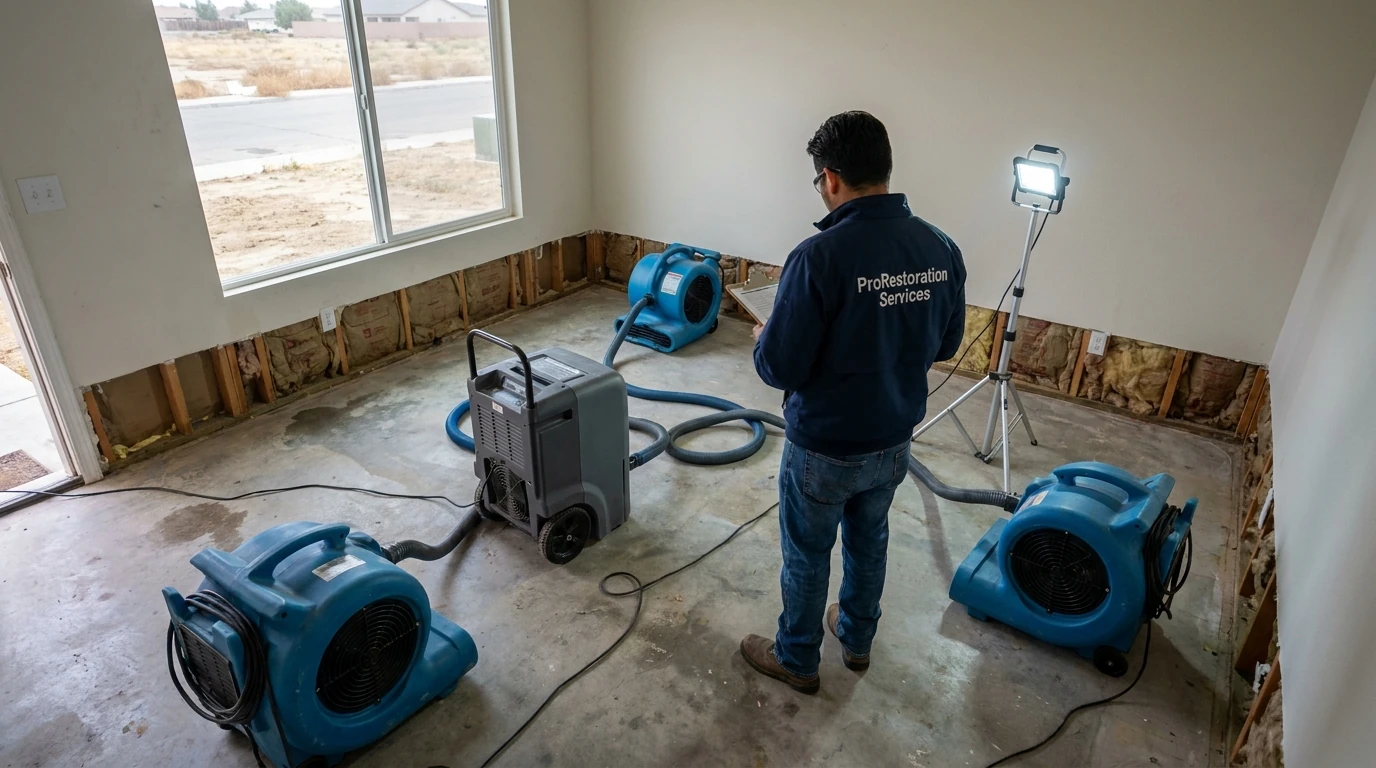
Structural drying. Commercial-grade air movers and low-grain refrigerant (LGR) dehumidifiers are placed according to a drying plan. In Bakersfield, summer ambient temperatures above 100 degrees Fahrenheit actually help drying times, though the equipment still runs until moisture readings reach the IICRC S500 target levels for the affected material class.
-
Daily monitoring. A technician returns each day to take moisture readings and adjust equipment placement. Drying typically takes three to five days for a Class 1 or 2 loss, and five to seven days or longer for Class 3 or 4.
-
Antimicrobial treatment. Applied after drying to exposed structural surfaces before reconstruction begins. Required for any Category 2 or 3 loss.
-
Reconstruction. Once the structure passes a final moisture check, the rebuild phase begins: new drywall, flooring, paint, and any cabinetry or trim that was removed. Reconstruction timelines depend on material availability and finish complexity.
What Should You Do Right Now?
If water damage is active or was just discovered, the most important thing is to stop the source and call for extraction as soon as possible. Every hour of additional saturation increases the affected area, the drying time, and the final cost. For a step-by-step guide to the first 24 hours, see what to do in the first 24 hours after water damage.
If the event has already been stabilized, the next step is a moisture assessment. Even if surfaces look dry, moisture can persist inside wall cavities, under flooring, and in subfloor assemblies. Undetected residual moisture is the primary cause of mold growth weeks after an apparent cleanup.
ProRestoration Services is available 24/7 for water damage emergencies in Bakersfield and across Kern County. Call (661) 393-9306 to schedule an assessment or request a written scope for an active or recent loss.
About ProRestoration Services
ProRestoration Services is an IICRC Certified, EPA Lead-Safe Certified Firm serving Bakersfield, CA and surrounding Kern County communities (license 960566, Contractors State License Board, State of California). Their crews handle water damage restoration, flood damage restoration, burst pipe repair, appliance leak cleanup, sewage cleanup, mold remediation, fire and smoke damage restoration, storm damage restoration, carpet cleaning, and full reconstruction. ProRestoration Services is BBB Accredited and available 24/7 for emergency response throughout the region.