If a pipe let go over the weekend at a storefront along the Rosedale Highway corridor or a sprinkler head discharged into a downtown Bakersfield office suite, the dollar question comes right after the panic: what is this going to cost, and what does insurance actually pay for? Commercial water damage restoration in Bakersfield typically runs $3,000 to $8,000 for a small office or retail space with clean water caught early, and can climb past $75,000 for a large footprint with Category 3 contamination or heavy demolition. Mitigation (extraction, drying, decontamination) and reconstruction (drywall, flooring, buildout) are almost always billed as two separate projects, even when one crew handles both.
What Does Commercial Water Damage Restoration Cost by Scenario?
Commercial water mitigation costs scale with square footage, water category, and how long materials sat wet, and most restoration contractors price mitigation-only work somewhere between $3 and $8 per square foot. Reconstruction is a separate line item on top of that.
| Scenario | Typical Mitigation Cost |
|---|---|
| Small office or retail space (under 1,000 sq ft), Category 1 clean water, caught within hours | $3,000 - $8,000 |
| Mid-size commercial space (1,000-5,000 sq ft), Category 2 gray water | $8,000 - $25,000 |
| Large warehouse or industrial floor, Category 3 black water or sewage backup | $25,000 - $75,000+ |
| Multi-tenant building, water traveled through multiple units or floors | $30,000 - $100,000+ |
| Reconstruction and buildout after mitigation (drywall, flooring, ceiling tile, fixtures) | Often equal to or greater than the mitigation bill, billed separately |
| After-hours or weekend emergency response | Roughly 15-30% above standard mitigation rates |
These are industry-typical ranges, not a quote. Every loss is different, and a written scope of work should spell out the actual number before anyone signs off on the job. For comparison, residential numbers for the same region run lower per square foot; see the California-wide residential water damage cost breakdown and the Bakersfield-specific residential numbers.
What Drives the Price Up or Down?
The biggest swing factors are the affected square footage, the water category, and how many hours passed before extraction started. Mold can begin growing on wet materials within 24 to 48 hours, so a slow response turns a mitigation job into a mitigation-plus-mold job fast.
Other cost drivers worth knowing before you get a scope:
- Water category. Category 1 (clean supply line) costs less to dry than Category 2 (gray water from an appliance or drain) or Category 3 (sewage, a backed-up floor drain, or anything from beyond the trap), which requires antimicrobial treatment and usually removal of porous materials rather than drying in place.
- Materials affected. Commercial carpet tile, VCT, ceiling grid, and office drywall all dry and price differently than residential finishes.
- After-hours labor. A Friday-night call costs more per hour than a Tuesday-morning one.
- Code upgrades. Older downtown Bakersfield and East Bakersfield buildings with outdated electrical or plumbing sometimes trigger code-required upgrades during reconstruction that weren’t part of the original loss.
Bakersfield’s slab-on-grade construction and hard water make slab leaks a recurring commercial loss source, and crews drying a commercial space generally follow the ANSI/IICRC S500 Standard for Professional Water Damage Restoration to decide when materials are actually dry rather than guessing.
Does Commercial Insurance Cover Water Damage?
Most commercial property policies cover sudden, accidental water damage in roughly the same way homeowners policies do, but gradual leaks, flood, and sewer or sump backup usually require separate endorsements, so the exact coverage depends entirely on the policy in hand. That makes a call to your broker or adjuster before work starts, not after, worth the ten minutes.
Documentation protects the claim regardless of carrier: photos of the damage before anything is touched, moisture readings logged daily, and a detailed written scope handed to the adjuster. A commercial restoration company that’s done this before should be building that paper trail as a normal part of the job, not as an afterthought.
Will My Policy Cover Lost Income While the Business Is Closed?
Business interruption coverage, when a policy includes it, typically pays for lost income and ongoing expenses during the restoration period, but it is usually a separate endorsement from the property damage coverage itself. Confirm it is actually on the policy before counting on it.
Regardless of what the policy covers, the fastest path to reopening is starting mitigation immediately. Every day a space sits wet adds to both the drying bill and the interruption clock.
What Happens During a Commercial Water Damage Restoration Job?
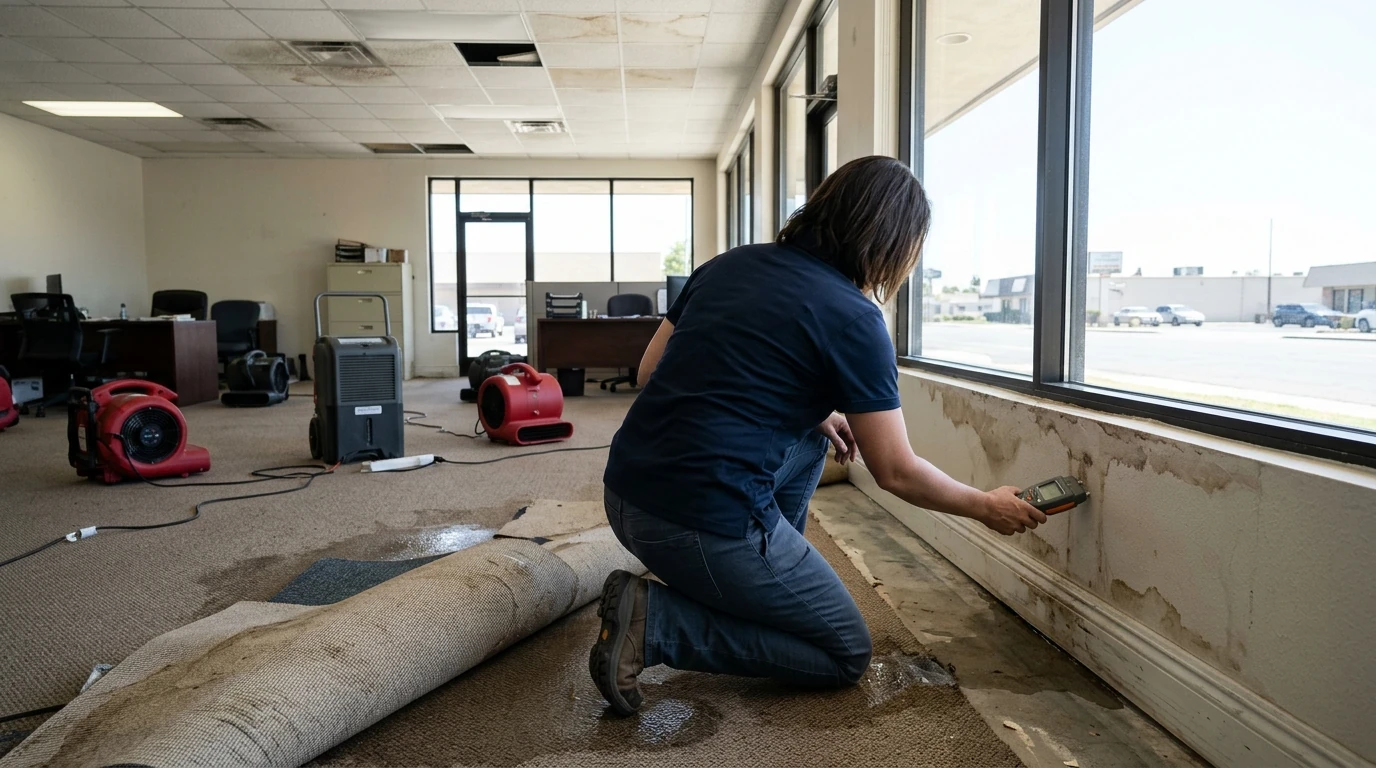
- Assessment and categorization. A technician identifies the water category, measures the affected square footage, and documents everything with photos and moisture readings.
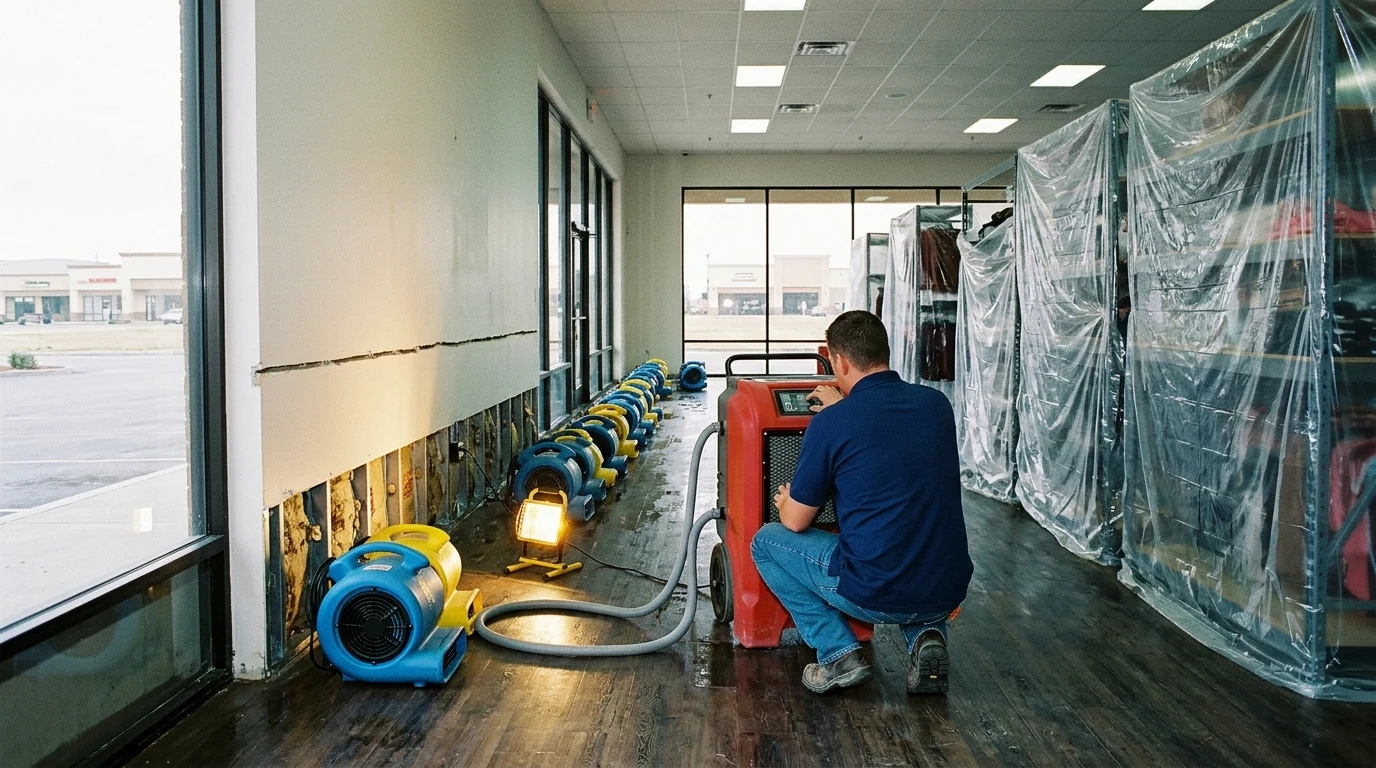
- Extraction and demolition. Standing water comes out first, then wet carpet, ceiling tile, or drywall that can’t be dried in place gets removed along a flood-cut line.
- Structural drying. Commercial-grade air movers and LGR dehumidifiers run until materials hit a dry standard confirmed by daily moisture monitoring, not a fixed number of days.
- Antimicrobial treatment. Category 2 and 3 losses get an EPA-registered antimicrobial application before anything is closed back up.
- Insurance documentation. The drying log, photos, and scope of work go to the adjuster as a complete package.
- Reconstruction. Drywall, flooring, paint, and any code-required upgrades happen as a separate phase, usually once the mitigation invoice is approved.
If the loss started with a failed supply line or a backed-up floor drain, the plumbing repair and the water damage mitigation don’t have to be two separate phone calls. ProRestoration and its sister company, All Pro Plumbing, run on a “One Call Does It All” model, so a property manager isn’t coordinating a plumber and a restoration contractor on two different schedules.
For a Bakersfield business dealing with standing water right now, getting a categorized assessment and a written scope started quickly keeps both the mitigation bill and the business-interruption clock as short as possible. Call ProRestoration Services at (661) 393-9306 for a 24/7 commercial water damage assessment anywhere in the Bakersfield and Kern County service area.
About ProRestoration Services
ProRestoration Services is a CSLB-licensed (#960566), IICRC Certified restoration company based in Bakersfield, CA, serving Kern County including Oildale, Rosedale, Delano, and Tehachapi. The company is also EPA Lead-Safe Certified and BBB Accredited, and its crews handle water damage restoration, emergency water removal, and reconstruction for commercial and residential properties across the region. ProRestoration works alongside sister company All Pro Plumbing on a one-call model for losses that start with a plumbing failure.